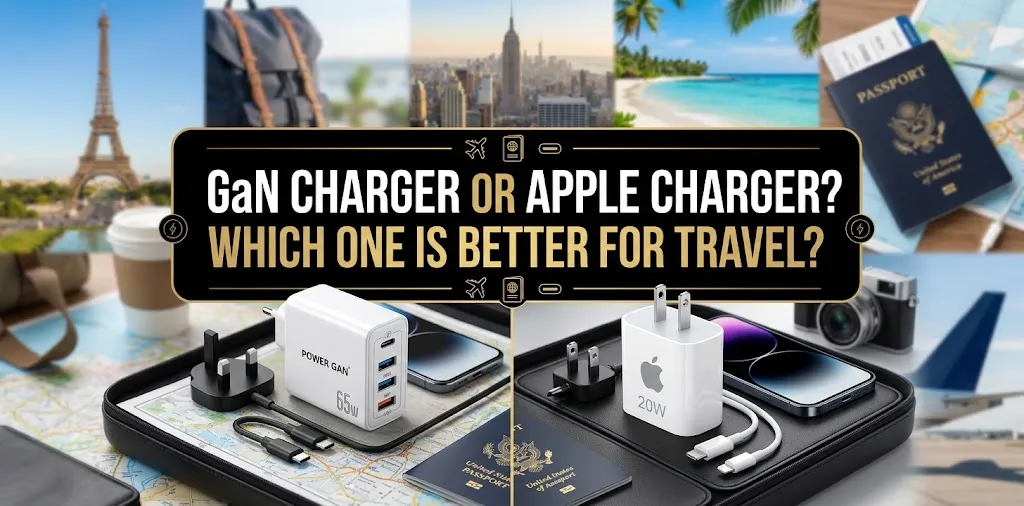
GaN charger or Apple charger? Which one is better for travel?

If you are choosing a charger specifically for travel, a GaN charger is usually the more practical option, especially if you need to charge an iPhone, iPad, AirPods, or MacBook with one charger. GaN models can offer higher power and multiple ports in a compact design. Apple chargers remain a simple choice if you want Apple’s own hardware and only need to charge one or two devices.
What Is the Difference Between a GaN Charger and an Apple Charger?
The biggest thing to understand is that these are not exactly two competing charger technologies.
GaN stands for gallium nitride, a semiconductor material used in many modern power adapters. It allows manufacturers to build compact chargers that can deliver a lot of power.
Apple charger usually means an Apple-branded power adapter, such as the 20W USB-C Power Adapter, 35W Dual USB-C Power Adapter, or newer 40W Dynamic Power Adapter with 60W Max. Apple also sells third-party GaN chargers from brands such as Anker and Belkin.
So the real travel comparison is often:
Compact multi-port GaN charger vs. Apple-branded power adapter.
| Feature | GaN charger | Apple charger |
|---|---|---|
| Size | Often very compact | Compact, depending on model |
| Power options | 30W to 100W+ is common | Several power levels available |
| Multiple devices | Many models have 2–4 ports | Some models have 2 ports |
| iPhone compatibility | Excellent with USB-C PD | Excellent |
| MacBook charging | Many models can handle it | Depends on wattage |
| Travel use | Very convenient for multiple devices | Simple and reliable |
| Cable included | Depends on the model | Usually sold separately |
| Brand choices | Many | Apple only for Apple-branded models |
Why GaN Chargers Are Useful for Travel
Travel creates a simple problem: you usually want to carry fewer things.
A single GaN charger can potentially replace several smaller adapters. For example, a 65W or 70W multi-port model can charge a phone, tablet, and laptop without requiring three separate wall chargers.
Apple itself sells GaN chargers from third-party brands through its online store. For example, Apple currently lists Anker 50W, 70W, and 150W GaN chargers, showing that GaN technology is fully compatible with Apple’s ecosystem.
Smaller packing footprint
A travel bag can fill up quickly with chargers.
A compact GaN charger can give you more charging power without taking up as much space. Belkin, for example, offers GaN travel chargers with multiple USB-C ports specifically for charging phones, tablets, and other devices while traveling.
More power from one charger
If you travel with a MacBook and iPhone, a basic 20W Apple adapter may not be enough to serve both devices conveniently.
A higher-wattage GaN charger can give you more flexibility. Some models provide 60W, 70W, or more from a single charger and divide power between multiple connected devices.
The important detail is that total wattage is not the same as wattage available to every port at the same time. Check the manufacturer’s power distribution table before buying.
Better for multi-device travel
Consider a hypothetical traveler carrying:
- iPhone
- AirPods
- iPad
- MacBook Air
Instead of packing several adapters, a multi-port GaN charger may let that person use one main charger and a few cables.
That can make a noticeable difference when moving between airports, hotels, and rental cars.
When an Apple Charger Makes More Sense
GaN is not automatically the right choice for everyone.
An Apple-branded adapter can make sense if you prefer Apple’s own accessories and do not need several charging ports.
Apple’s 30W USB-C Power Adapter, for example, is compatible with USB-C devices and is designed for use with products such as MacBook Air, iPhone, and iPad models. Apple lists the U.S. price at $39, with the charging cable sold separately.
You only carry one main device
If your travel setup is simply an iPhone and perhaps AirPods, you may not need a large multi-port charger.
A small Apple USB-C adapter can be enough, especially when paired with the correct cable.
You prefer Apple’s accessories
Some people simply want Apple-branded accessories throughout their setup.
Apple also states that iPhone can be charged with compliant third-party power adapters, so using a reputable GaN charger does not mean you have to use an Apple-branded adapter.
You want a simple setup
There is value in keeping things straightforward.
If you already own an Apple adapter that provides the power you need, buying another charger just because it uses GaN technology may not provide much benefit.
Is a GaN Charger Safe for an iPhone?
Yes, a reputable third-party USB-C charger can be used with an iPhone when it meets the appropriate standards and specifications.
Apple specifically says iPhone can be charged using third-party cables and power adapters that comply with USB standards and applicable safety requirements. For fast wired charging, Apple recommends a USB-C Power Delivery charger and appropriate cable for newer USB-C iPhone models.
The important part is charger quality, not simply whether the charger says “GaN.”
A cheap, poorly made charger can be a bad choice even if it uses GaN technology. Look for a reputable manufacturer, appropriate safety certifications, USB Power Delivery support, and clear power specifications.
What Wattage Should You Choose for Travel?
The right wattage depends on what you are carrying.
| Travel setup | Practical charger range |
|---|---|
| iPhone only | 20W–30W |
| iPhone + AirPods | 20W–35W |
| iPhone + iPad | 30W–50W |
| iPhone + iPad + other accessories | 50W–70W |
| iPhone + MacBook Air | 60W–70W |
| MacBook + phone + other devices | 65W–100W+ |
These are practical ranges rather than strict requirements. Your specific device determines how much power it can actually use.
Apple’s current 40W Dynamic Power Adapter, for example, can provide up to 60W under its specified conditions and is compatible with USB-C devices.
Does Higher Wattage Mean Faster iPhone Charging?
Not necessarily.
A 100W charger does not force 100W into an iPhone. The phone and charger communicate and determine the appropriate charging power.
Apple says newer iPhones can use USB-C Power Delivery chargers for faster wired charging, while the actual charging speed depends on the iPhone, charger, cable, temperature, and other conditions.
So buying a much higher-wattage charger is mainly useful when you also have devices that can use the extra power, such as an iPad or MacBook.
What About Charging Multiple Devices at Once?
This is one of the biggest reasons to consider a GaN charger for travel.
Suppose a charger has three USB-C ports and a 100W total rating. That does not necessarily mean every port can provide 100W simultaneously.
The charger may divide its available power among the connected devices.
For example, a manufacturer could design a charger that provides high power when one device is connected but reduces the output when two or three devices are plugged in.
Apple also notes that multi-port charging can reduce the maximum power available to an individual device depending on the combined power requirements.
Always check the port-by-port output before purchasing.
Which Is Better for Different Types of Travelers?
For a phone-only traveler
A compact 20W–30W charger is usually enough.
There is little reason to carry a large 100W charger if your only important device is an iPhone.
For an iPhone and iPad traveler
A 30W–50W charger with two USB-C ports can be more convenient.
You can keep both devices connected without carrying separate wall adapters.
For a MacBook traveler
A 60W–70W GaN charger can be useful if you want one compact adapter for your laptop and smaller devices.
For heavier laptops, check the MacBook’s required charging power before choosing the charger.
For family travel
Multiple ports become more useful when several people need to charge devices.
A 70W or higher multi-port GaN charger can reduce the number of adapters competing for hotel outlets. Belkin currently lists 50W dual-port and 70W three-port GaN travel options for multi-device use.
What Should You Check Before Buying a Travel Charger?
Do not look at wattage alone.
Check these points:
- USB-C Power Delivery: Important for fast charging many modern devices.
- Number of ports: More ports can reduce the number of adapters you need.
- Power distribution: Check how much power each port gets when multiple devices are connected.
- Size: A high-wattage charger is less useful for travel if it is unnecessarily large.
- Plug design: Foldable or compact plugs can make packing easier.
- Voltage compatibility: Check that the charger supports the electrical standards needed for your destination.
- Cable compatibility: A charger may not include the cable you need.
- Manufacturer reputation: Avoid unknown chargers with unclear specifications.
- Safety certifications: Look for appropriate compliance and protection features.
GaN Charger vs Apple Charger: Which Should You Pick?
For travel, the choice depends mostly on how many devices you carry.
Choose a GaN charger if:
- You want one charger for several devices.
- You travel with a MacBook or iPad.
- You want multiple USB-C ports.
- Saving bag space matters.
- You want higher power in a compact package.
Choose an Apple charger if:
- You mainly charge one Apple device.
- You prefer Apple-branded accessories.
- You already own an Apple adapter that meets your needs.
- You do not need multiple high-power ports.
One useful middle ground is a reputable third-party GaN charger sold through Apple’s store. Apple currently sells several Anker and other third-party charging products alongside its own adapters.
Is a GaN Charger Better for International Travel?
GaN technology itself does not make a charger automatically suitable for international travel.
What matters is the charger’s input voltage range and plug configuration.
Many modern power adapters support 100–240V input, but you should verify the specifications of the exact model before traveling internationally. Apple’s current 40W Dynamic Power Adapter, for example, is specified for 50–60 Hz and 100–240V input.
You may still need a plug adapter depending on the country you visit.
For international trips, check the destination’s outlet type before leaving.
What About MagSafe Charging While Traveling?
If you use MagSafe, the charger and power adapter both matter.
Apple recommends a compatible USB-C power adapter for MagSafe, and newer iPhone models can support higher wireless charging speeds with the appropriate adapter and conditions.
A GaN USB-C charger can therefore be useful for powering a MagSafe charger while traveling, provided it meets the required power specifications.
FAQ
Can I use a GaN charger with an iPhone?
Yes. A reputable GaN charger with suitable USB-C Power Delivery support can charge an iPhone. Apple supports compliant third-party power adapters and cables.
Is a GaN charger better than Apple’s 20W charger for travel?
It depends on your devices. A GaN charger can be more useful when you need multiple ports or enough power for an iPad or MacBook, while Apple’s 20W adapter can be sufficient for a simple iPhone-focused setup.
What is the best wattage for a travel GaN charger?
For many Apple-focused travel setups, 30W–70W covers a useful range. Choose based on the devices you carry and whether you need to charge several devices at the same time rather than choosing the highest wattage available.
Final Takeaway
For travelers carrying several Apple devices, a compact GaN charger offers more flexibility with power, ports, and packing space. An Apple charger can still be a straightforward option when you only need a simple single-device setup.
Before buying, focus on USB-C PD support, wattage, port power distribution, size, voltage compatibility, and charger quality. Those details matter more for travel than the word “GaN” printed on the box.