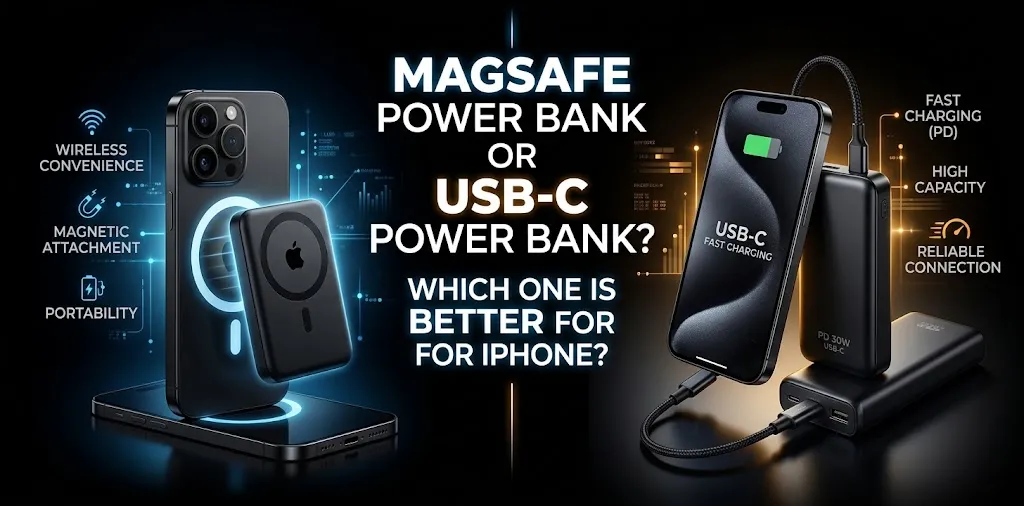
MagSafe power bank or USB-C power bank? Which one is better for iPhone?

If you want the simplest way to keep an iPhone charged while traveling, a MagSafe power bank is more convenient, while a USB-C power bank is usually more flexible and efficient. MagSafe is better for cable-free charging while using your phone. USB-C is better when charging speed, battery capacity, and charging multiple devices matter most.
MagSafe Power Bank vs USB-C Power Bank for iPhone
The main difference is how the power reaches your iPhone. A MagSafe power bank attaches magnetically to compatible iPhones and charges wirelessly. A USB-C power bank connects with a cable, giving you a direct wired connection.
| Feature | MagSafe Power Bank | USB-C Power Bank |
|---|---|---|
| Charging method | Wireless magnetic | Wired |
| Cable needed for iPhone | No | Yes |
| Ease of use | Very convenient | Simple but requires a cable |
| Charging efficiency | Generally lower than wired charging | Generally higher |
| Heat | Can produce more heat during wireless charging | Usually less heat |
| Battery capacity options | Often focused on compact designs | Wide range of capacities |
| Charging while using iPhone | Easy, but adds weight to the phone | Easy with a cable |
| Multiple-device charging | Depends on the model | Usually more flexible |
| Best for | Convenience and portability | Speed, efficiency, and flexibility |
Apple supports both wired charging and wireless charging on compatible iPhone models. For wired fast charging, Apple recommends a USB-C cable and a compatible USB Power Delivery adapter for iPhone 15 and later.
How MagSafe Power Banks Work
A MagSafe power bank uses magnets to attach to the back of a compatible iPhone or MagSafe case. The magnetic alignment helps keep the charging coil in the correct position while you use the phone.
That makes MagSafe especially convenient when you do not want a cable hanging from your phone. You can attach the battery, put the phone in your hand or pocket, and continue using it.
Apple says supported MagSafe accessories attach to the back of an iPhone or a compatible MagSafe case, with the magnets helping maintain proper alignment for wireless charging.
Many newer magnetic power banks also use Qi2 technology. Qi2 is a wireless charging standard that uses magnetic alignment on compatible accessories. Because of this, you may see products described as “MagSafe-compatible,” “magnetic,” or “Qi2” rather than simply calling them MagSafe power banks.
The biggest advantage: no cable
For short top-ups, the convenience can be more important than maximum charging efficiency.
For example, imagine you are walking around a city and your iPhone battery drops to 25%. A magnetic power bank can attach to the back of the phone without requiring you to connect a cable. That can be useful for maps, messages, photos, and other everyday tasks.
The biggest drawback: wireless charging is less efficient
Wireless charging normally wastes more energy as heat than wired charging. That means the power bank’s stated capacity does not translate directly into the same amount of battery added to your iPhone.
Heat can also affect charging behavior. Apple notes that charging can be limited when the iPhone becomes too warm.
How USB-C Power Banks Work
A USB-C power bank sends power to your iPhone through a USB-C cable. On iPhone 15 and later, you can connect the power bank directly to the phone with a USB-C cable.
This approach is less visually convenient than magnetic charging, but it has an important advantage: wired charging is generally the better choice when you want efficient power delivery and faster charging.
Apple supports USB Power Delivery for fast charging and says iPhone 15 and later can fast charge with a USB-C cable and a compatible USB-C PD power source.
You can use the power bank for more devices
A USB-C power bank can be useful beyond your iPhone.
Depending on its ports and power output, the same battery can potentially charge devices such as:
- iPhone
- iPad
- AirPods
- Android phones
- USB-C accessories
- Some laptops
This makes a USB-C power bank especially useful for travel or people who carry several electronic devices.
Which One Charges an iPhone Faster?
For most situations, USB-C wired charging is the better option when charging speed is the priority.
The exact charging speed depends on the iPhone model, cable, power bank, power output, battery temperature, and other conditions. A power bank with a very high wattage rating does not automatically mean the iPhone will charge at that same wattage.
Apple’s current charging guidance shows that compatible iPhone models can use higher-power USB-C charging, while MagSafe wireless charging has its own model and accessory requirements.
For example, Apple’s current MagSafe Charger can provide up to 25W of peak wireless power on supported iPhone models under the right conditions, but actual power varies by iPhone model and charging conditions.
A USB-C power bank is therefore the more straightforward choice if you care mainly about getting power into the phone as efficiently and quickly as possible.
Which One Is Better for Travel?
The answer depends on how you travel.
A MagSafe power bank can be convenient for walking around, sightseeing, commuting, or using your phone for navigation. There is no cable to connect and disconnect every time you need a charge.
A USB-C power bank can be more useful on longer trips because it can provide wired charging and may have a larger battery capacity or multiple ports.
For example, if you are taking a short day trip and mainly need extra battery for maps and photos, a compact magnetic battery can be convenient.
If you are flying, working remotely, and carrying an iPhone, iPad, AirPods, and other USB-C devices, a USB-C power bank gives you more flexibility.
What About Battery Capacity?
Power bank capacity is usually listed in mAh, but mAh alone does not tell you exactly how many times a power bank will charge an iPhone.
Energy is also affected by voltage, conversion losses, wireless charging losses, and the power bank’s charging system.
A larger-capacity USB-C power bank can therefore be a better choice if your main goal is to keep an iPhone running for a long period.
Magnetic power banks often focus more on portability. Some are slim enough to carry comfortably on the back of the phone, while larger magnetic batteries can provide more capacity but add more weight.
Apple’s current accessory store lists both compact magnetic power banks and larger magnetic power banks, showing that capacity and physical size vary considerably between products.
Which One Is Easier to Use While Using Your iPhone?
A MagSafe power bank has a clear advantage here.
Because it attaches directly to the back of the phone, you can hold the iPhone without managing a charging cable. This can be useful when taking photos, checking directions, or using your phone while walking.
A USB-C power bank requires a cable, which can be slightly less convenient. However, you can place the power bank in a bag or pocket while the cable reaches the phone, which may actually be more comfortable for some users.
There is also a trade-off: attaching a magnetic battery to the phone makes the phone thicker and heavier.
What If You Have a MagSafe Case?
A compatible MagSafe case can make a magnetic power bank easier to use.
The case needs to support the magnetic connection properly. A very thick case or a case without the appropriate magnetic system may weaken the connection or prevent reliable alignment.
If you use a wallet or another accessory on the back of the phone, you may also need to remove it before attaching a magnetic charger or battery.
Apple specifically warns against placing credit cards, security badges, passports, or key fobs between an iPhone and a MagSafe charger because the magnets can affect magnetic strips or RFID-related components.
Which Power Bank Should You Choose?
The better choice depends on what you value most.
Choose a MagSafe power bank if you:
- Want cable-free charging
- Prefer a compact setup
- Frequently use your iPhone while charging
- Like magnetic accessories
- Mostly need short battery top-ups
- Already use a compatible MagSafe case
Choose a USB-C power bank if you:
- Want efficient wired charging
- Care about charging speed
- Need more battery capacity
- Want to charge several types of devices
- Travel with multiple USB-C devices
- Do not mind carrying a cable
There is also a middle-ground option: a magnetic power bank with a USB-C port. You can use magnetic wireless charging when convenience matters and connect a USB-C cable when you want wired charging.
Are MagSafe Power Banks Worth It for iPhone?
For someone who values convenience, a MagSafe power bank can be worth the extra cost and lower efficiency of wireless charging.
The biggest benefit is not necessarily that it adds more battery. It is that you can charge without plugging in a cable.
For someone who spends long days away from an outlet, however, a USB-C power bank may make more sense. Wired charging can be more efficient, and USB-C models are available in many different capacities and configurations.
The choice comes down to whether convenience or charging flexibility matters more to you.
MagSafe Power Bank or USB-C Power Bank: Which Is Better for You?
A MagSafe power bank is better for convenient, cable-free charging, especially when you want to keep using your iPhone while it charges. A USB-C power bank is better for wired charging, efficiency, capacity, and charging multiple devices.
For everyday iPhone users who mainly want an easy emergency top-up, the magnetic option can be very convenient. For travelers, heavy users, or people carrying several devices, USB-C offers more flexibility.
Before buying, check your iPhone model, the power bank’s charging standard, USB-C output, battery capacity, physical size, and whether your case supports magnetic charging.
Frequently Asked Questions
Here are some common questions about MagSafe and USB-C power banks for iPhone, including charging speed, compatibility, and which option makes more sense for different types of users.
Can I charge an iPhone with a USB-C power bank?
Yes. iPhone 15 and later models use USB-C, so you can connect them directly to a USB-C power bank with a compatible cable. Older iPhones can also use a USB power bank with the appropriate cable for their charging port.
Is a MagSafe power bank better than a regular power bank?
A MagSafe power bank is more convenient because it attaches magnetically and does not require a charging cable. A regular USB-C power bank can be more useful when you want efficient wired charging, higher capacity, or support for several devices.
Does a MagSafe power bank work with every iPhone?
No. Magnetic attachment depends on the iPhone model and compatible case or accessory. iPhones without the appropriate magnetic system may still support wireless charging, but they will not necessarily have the same magnetic attachment experience.
The Bottom Line
MagSafe and USB-C power banks solve the same basic problem in different ways. MagSafe focuses on convenience and cable-free charging, while USB-C focuses on wired power delivery, flexibility, and broader device support.
If you mainly want a simple battery boost while using your iPhone, look at magnetic options. If you want one power bank for longer trips and multiple devices, compare USB-C models and their power output, capacity, and number of ports before buying.