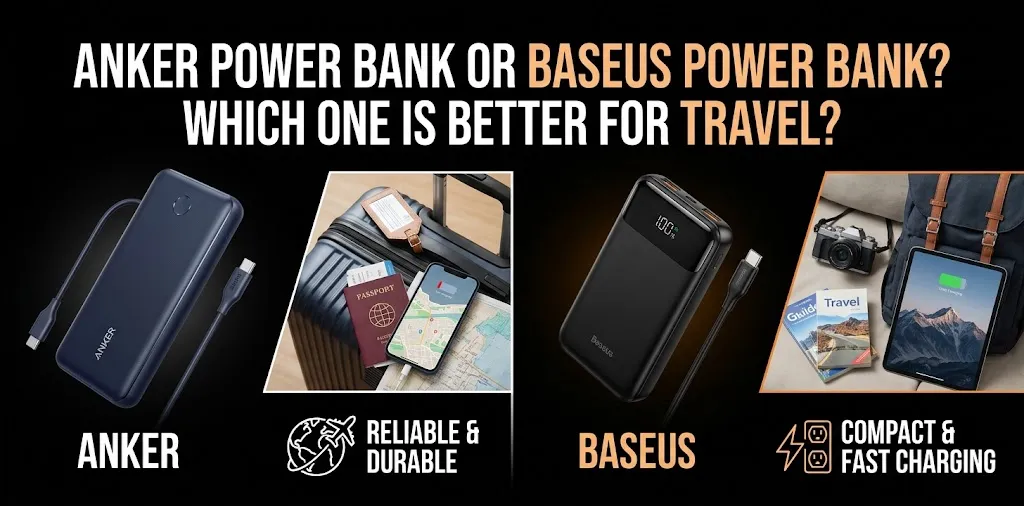
Anker power bank or Baseus power bank? Which one is better for travel?

For travel, Anker and Baseus both offer strong power banks, but they suit different types of travelers. Anker has options focused on compact design, charging reliability, and safety features, while Baseus offers several high-capacity models with useful travel features such as built-in cables, digital displays, and high USB-C output. Your best choice depends on your devices, trip length, and airline limits.
Anker vs. Baseus for Travel
A travel power bank needs to do more than hold a large battery. Size, weight, charging speed, ports, recharge time, and airline rules all matter.
Anker and Baseus both sell models ranging from small phone-focused chargers to larger power banks capable of charging tablets and USB-C laptops. Because the brands have many models, comparing the brands alone can be misleading. A 10,000mAh Anker model and a 20,000mAh Baseus model are designed for very different travel needs.
| Travel factor | Anker | Baseus |
|---|---|---|
| Phone charging | Strong selection | Strong selection |
| Laptop charging | Many high-output models | Many high-output models |
| Compact options | Yes | Yes |
| Built-in cables | Available on some models | Available on some models |
| Digital displays | Available on some models | Available on some models |
| Large-capacity options | Available | Available |
| Travel suitability | Depends on model | Depends on model |
| Airline use | Depends on battery Wh rating | Depends on battery Wh rating |
The key point is to choose the specific power bank, rather than assuming every model from one brand is better for travel.
When Anker Makes More Sense for Travel
Anker has a wide range of portable chargers, from small models designed mainly for smartphones to high-output power banks for laptops.
For example, the Anker 737 Power Bank (PowerCore 24K) has a 24,000mAh capacity, two USB-C ports and one USB-A port, with up to 140W total output. Its listed weight is 607g, so it offers substantial capacity but is not the type of power bank most people would want in a pocket.
Anker also offers smaller travel-focused options. One example is its 20,000mAh Zolo model, which includes built-in USB-C and Lightning cables and supports up to 30W charging. That can reduce the number of separate cables you need to pack.
Anker may fit your trip particularly well if you care about:
- A broad range of sizes and charging capacities
- High USB-C output for compatible laptops
- Built-in cable options
- A compact charger for everyday phone use
- A power bank with detailed battery and charging information
The important thing is to check the specifications of the exact Anker model before buying.
When Baseus Makes More Sense for Travel
Baseus also has a broad power-bank lineup, including compact magnetic models and larger laptop-capable chargers.
The Baseus Blade, for example, has a 20,000mAh capacity and up to 100W USB-C output. Baseus lists the standard Blade at about 506g, while the Blade HD is listed at about 445g. Both are designed around a slim form factor rather than the shape of a traditional thick power bank.
Baseus also sells models with built-in USB-C cables. Its EnerFill FC41, for example, has a 20,000mAh capacity, 100W PD charging, dual built-in USB-C cables, pass-through charging, and a digital display.
That can be useful for travelers who want fewer accessories in their bag.
Baseus may fit your needs if you value:
- High capacity in a relatively slim design
- Laptop charging
- Built-in charging cables
- Digital battery information
- Multiple charging ports
- A wide selection of travel-oriented designs
Baseus itself recommends 20,000mAh to 30,000mAh and 65W to 100W for longer trips, while suggesting smaller 5,000mAh to 10,000mAh models for shorter outings.
Which Capacity Is Better for Travel?
Capacity should match your trip rather than simply being as large as possible.
A 10,000mAh power bank is often easier to carry and can make sense for a day of sightseeing when your main concern is keeping your phone running.
A 20,000mAh model gives you more backup for longer days, multiple devices, or trips where you may not have regular access to an outlet.
A larger power bank can be useful for laptops and several devices, but it also tends to add weight. That matters when you are already carrying a backpack, laptop, camera, and other travel gear.
For many travelers, 20,000mAh is a useful middle ground. But capacity alone does not tell you whether a power bank is suitable for a flight.
Check Watt-Hours Before Flying
If you’re choosing a power bank specifically for air travel, watt-hours (Wh) matter more than the mAh number printed on the box.
The FAA currently says spare lithium-ion batteries and power banks must be carried in carry-on baggage, not checked baggage. Batteries from 0–100Wh are allowed under the stated rules, while 101–160Wh batteries require airline approval and are limited to two spare batteries. Batteries above 160Wh are not permitted on passenger aircraft. Airlines can also impose stricter requirements.
You can calculate Wh with:
Wh = volts × amp-hours
Or, using the capacity printed in mAh:
Wh = volts × mAh ÷ 1,000
For example, a 20,000mAh power bank rated around 3.7V internally works out to about 74Wh. That is why many 20,000mAh travel power banks fall below the FAA’s 100Wh threshold.
Always check the actual Wh rating printed on your power bank and your airline’s current rules before flying.
Don’t Put Your Power Bank in Checked Luggage
This is one of the most important travel rules.
Power banks are spare lithium-ion batteries, so the FAA requires them to remain in your carry-on baggage rather than your checked suitcase. If your carry-on is taken at the gate and placed in the aircraft’s cargo hold, the FAA says you should remove the power bank and keep it with you in the cabin.
It is also smart to protect the power bank from crushing, damage, or accidental short circuits. Damaged or recalled lithium batteries should not be brought onto an aircraft.
Anker or Baseus for Different Types of Trips
The right choice changes depending on how you travel.
For a weekend city trip
If you’re mainly charging an iPhone, Samsung Galaxy, or Google Pixel, a compact 10,000mAh model can be easier to carry than a heavy laptop power bank.
You probably do not need 100W output if your only concern is your phone.
For a long international trip
A 20,000mAh model can make more sense when you expect long airport waits, train rides, sightseeing days, or limited access to outlets.
Look for a model that offers enough capacity without adding unnecessary weight to your carry-on.
For laptop travel
If you travel with a USB-C laptop, pay attention to USB-C Power Delivery output, not just battery capacity.
A 20,000mAh power bank with 100W output can be much more useful for a compatible laptop than a larger power bank that only provides low-wattage charging.
For example, Baseus lists its Blade at up to 100W USB-C output, while Anker’s 737 supports up to 140W total output.
For traveling with several devices
If you carry a phone, earbuds, tablet, smartwatch, and laptop, check the number and type of ports.
Multiple ports can be convenient, but remember that the maximum output may be shared when several devices are connected. Look at the manufacturer’s output table rather than assuming every port can deliver the maximum wattage at the same time.
What About Weight?
Weight is easy to overlook when shopping online.
A large power bank may provide more charging capacity, but you have to carry that weight through airports, hotels, and daily sightseeing.
For example, the Anker 737 is listed at 607g, while Baseus lists its Blade models at roughly 445g to 506g depending on the version.
If your trip involves lots of walking, a smaller power bank may be more practical than buying the highest-capacity model available.
Which Features Actually Matter for Travel?
Some features can make a real difference while traveling.
USB-C Power Delivery: Useful if you want to charge newer phones, tablets, or laptops.
Built-in cables: Convenient when you do not want to pack separate charging cables.
Battery display: Helpful when you want to know exactly how much charge remains.
Pass-through charging: Can be useful in some travel setups, but check the manufacturer’s instructions because supported charging combinations vary.
Multiple ports: Helpful when traveling with several devices.
Compact design: Important if your power bank will stay in a small personal bag.
Protection features: Overcurrent, overvoltage, short-circuit, and temperature protection can help protect the charger and connected devices. Baseus, for example, lists multiple protection functions on its Blade power bank.
Anker vs. Baseus: What Should You Actually Buy?
Instead of choosing by brand name alone, start with your travel setup.
If you only need emergency phone power, look for a small 10,000mAh model with enough output for your phone.
If you need several phone charges during long travel days, a 20,000mAh model is a more useful starting point.
If you are carrying a USB-C laptop, look for 65W or higher USB-C Power Delivery, depending on your laptop’s requirements.
If you want to reduce the number of accessories in your bag, consider a model with built-in cables.
If you’re flying, check the Wh rating and airline requirements before purchasing, rather than relying only on the advertised mAh capacity.
Frequently Asked Questions
Still deciding between Anker and Baseus for your next trip? These common questions cover the key things to consider, including airline rules, battery capacity, and which features matter most when choosing a travel power bank.
Is Anker or Baseus better for international travel?
Both brands offer power banks suitable for travel. The specific model matters more than the brand because capacity, weight, output, and Wh rating vary significantly between models.
Can I take an Anker or Baseus power bank on a plane?
Yes, power banks can generally be carried in your carry-on when they meet applicable battery limits. The FAA says spare lithium-ion batteries and power banks cannot be placed in checked baggage, and airline rules may be stricter.
Is a 20,000mAh power bank too big for flying?
Not necessarily. A 20,000mAh power bank can be below the FAA’s 100Wh limit, depending on its battery voltage, but you should check the actual Wh rating printed on the device and confirm your airline’s current requirements before flying.
The Bottom Line
For travel, don’t choose between Anker and Baseus based only on brand reputation. Match the power bank to your devices, trip length, weight limit, charging speed needs, and airline requirements.
For a typical traveler, 20,000mAh is a useful capacity to consider, while phone-only travelers may prefer something smaller. If you’re carrying a laptop, focus on USB-C Power Delivery wattage as well as capacity.
Before your flight, check the power bank’s Wh rating and your airline’s rules, and keep the power bank in your carry-on.