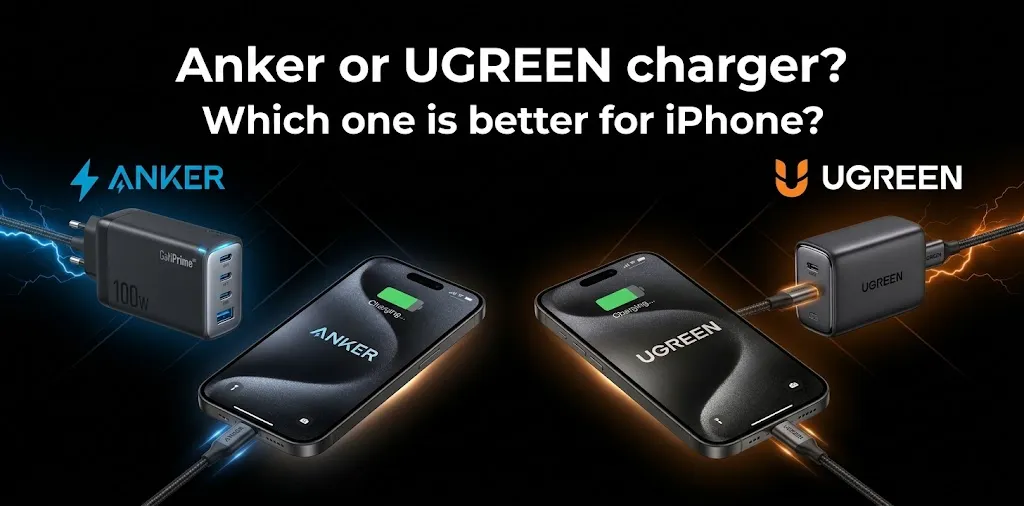
Anker or UGREEN charger? Which one is better for iPhone?

Both Anker and UGREEN make USB-C chargers that can work well with iPhones. Anker is often a strong choice for compact chargers, travel, and a wide range of charging accessories, while UGREEN offers many high-power and multi-port options. For an iPhone, the right choice depends more on the charger’s USB Power Delivery support, wattage, ports, size, and your other devices than the brand alone.
Apple says iPhones can use comparable third-party USB-C power adapters that support USB Power Delivery (USB-PD) for fast charging. The exact power you need depends on your iPhone model.
Anker vs UGREEN at a glance
| Factor | Anker | UGREEN |
|---|---|---|
| iPhone compatibility | Excellent with compatible USB-C PD models | Excellent with compatible USB-C PD models |
| Compact chargers | Many small options | Many compact options |
| Multi-port charging | Wide selection | Wide selection |
| High-wattage chargers | Strong selection | Strong selection |
| GaN chargers | Yes | Yes |
| Best for | Compact, simple, travel-friendly charging | Multi-device and high-power setups |
| Main buying factor | Choose the right model and wattage | Choose the right model and wattage |
The important point is that Anker is not automatically better than UGREEN, or vice versa. A 20W Anker charger and a 65W UGREEN charger serve different purposes, so comparing brands without comparing specific models can be misleading.
How Anker and UGREEN chargers differ for iPhone
The biggest differences are usually found in the individual charger rather than the company name.
Anker has a large range of compact USB-C chargers designed for phones and other devices. Its smaller chargers can be useful if you want something easy to carry in a pocket, purse, or travel bag. Anker also sells larger chargers for iPhone, iPad, MacBook, and other devices.
UGREEN also offers chargers ranging from small phone adapters to high-output multi-port GaN chargers. Its larger models can be useful when you want one charger to power an iPhone, iPad, laptop, earbuds, or other USB devices.
For example, UGREEN currently offers 20W and 30W multi-port USB-C chargers that use USB Power Delivery.
Charging speed
Wattage matters, but a higher number on the charger does not mean your iPhone will continuously charge at that wattage.
Your iPhone controls how much power it accepts. A higher-wattage charger can provide extra capacity, but the phone will only draw what it is designed to use under the current charging conditions.
Apple’s current guidance shows why the iPhone model matters. Apple says an iPhone 17, iPhone 17 Pro, or iPhone 17 Pro Max can reach up to 50% in about 20 minutes when paired with a 40W or higher adapter. The iPhone 17e and iPhone Air can reach up to 50% in about 30 minutes with a 20W or higher adapter.
So if you have a newer iPhone, buying a charger based only on the old 20W standard may not make sense if faster charging is one of your priorities.
USB Power Delivery matters more than the logo
For wired fast charging, look for USB-C Power Delivery (USB-PD).
Apple specifically states that a comparable third-party USB-C adapter supporting USB-PD can be used for fast charging.
This means an appropriately rated Anker or UGREEN USB-C PD charger can be a suitable alternative to Apple’s own power adapter.
Instead of asking only, “Is Anker better than UGREEN?” check:
- Does the charger support USB-PD?
- How many watts does it provide?
- How many ports does it have?
- How does it distribute power when several devices are connected?
- Is the plug and design convenient for your use?
- Does it come from a reputable seller?
When Anker makes more sense
Anker can make sense if you want a small charger primarily for your iPhone and everyday travel.
Its product range includes compact chargers designed to provide substantial power from a relatively small adapter. Tom’s Guide, for example, has highlighted Anker’s small 20W charger for its compact size and phone-charging capability.
Anker is also useful if you already use other Anker accessories. Keeping your charging setup within one ecosystem can make it easier to find compatible cables, power banks, charging stations, and replacement accessories.
For a simple setup, you may not need a large multi-port charger. A compact USB-C PD adapter with enough power for your iPhone can be easier to carry and use.
When UGREEN makes more sense
UGREEN can be especially useful if your iPhone is only one of several devices you need to charge.
The company’s charger lineup includes multi-port models and high-wattage GaN chargers. That can be useful for someone who wants to charge an iPhone and another USB-C device from the same wall outlet.
UGREEN’s multi-port chargers can also make sense for a desk or travel bag where carrying several separate power adapters would be inconvenient.
Third-party testing has also found UGREEN’s GaN chargers useful for powering multiple devices, including iPhones, iPads, AirPods, and laptops from a single charger.
A simple example
Imagine you only carry an iPhone 17 and AirPods. A small USB-C PD charger may be all you need.
Now imagine you travel with an iPhone, iPad, MacBook Air, and AirPods. A higher-wattage UGREEN or Anker multi-port GaN charger could be more practical because you can reduce the number of adapters in your bag.
The better choice changes because the charging setup changed.
Do you need a 20W, 30W, or 40W+ charger for an iPhone?
There is no single wattage that is right for every iPhone user.
| Charger size | Good fit for |
|---|---|
| 20W | Basic fast charging and smaller iPhone setups |
| 30W | iPhone plus some extra power for other USB-C devices |
| 40W+ | Newer iPhones that support faster charging and multi-device use |
| 65W+ | iPhone plus tablets, laptops, or several devices |
| 100W+ | Larger multi-device setups, especially with USB-C laptops |
A 100W charger does not force 100W into an iPhone. The phone negotiates the power it needs.
For example, if you buy a 65W UGREEN charger because you also have a USB-C laptop, that does not mean the iPhone itself will charge at 65W continuously.
The extra capacity is useful because the charger can also power other compatible devices.
GaN chargers: Anker vs UGREEN
Both brands sell GaN chargers.
GaN stands for gallium nitride. It allows charger manufacturers to build efficient, relatively compact power adapters that can deliver substantial power.
For iPhone users, GaN is most useful when you want a small charger with more power or several ports.
A compact GaN charger can be convenient for travel because one adapter may replace multiple larger charging bricks.
But you do not need GaN simply because you own an iPhone. If a basic USB-C PD charger already meets your needs, there is no requirement to upgrade to a GaN model.
What about battery safety?
A reputable charger should have appropriate protection features, but you should still pay attention to the specific model.
Avoid choosing a charger solely because it has the highest wattage or the lowest price. Check the manufacturer’s specifications and buy from a reputable retailer.
Also check the cable. A suitable USB-C cable is necessary to take advantage of the charging capabilities of your iPhone and adapter.
Apple notes that charging performance can vary with factors such as temperature and the charging setup.
Anker or UGREEN for travel?
For travel, size and port selection can matter more than maximum wattage.
If you only need to charge an iPhone, a compact Anker or UGREEN USB-C PD charger can be easier to pack.
If you are traveling with several devices, a multi-port charger may be more useful. One charger can potentially handle your iPhone, AirPods, iPad, and other USB-C devices instead of taking several separate adapters.
UGREEN’s higher-output chargers have been used in multi-device setups, while Anker also offers compact chargers and multi-device charging products.
Which should you choose for your iPhone?
Choose Anker if your priority is a compact, straightforward charger for your iPhone, especially if you also want other Anker charging accessories.
Choose UGREEN if you want more flexibility for charging several devices or are looking for a high-wattage multi-port setup.
For either brand, check the exact model before buying. A well-matched 20W, 30W, or 40W+ USB-C PD charger can be more useful than simply choosing one brand over another.
If you have an older iPhone
Older Lightning iPhones can still use compatible USB-C power adapters with the appropriate USB-C-to-Lightning cable. Apple lists USB-C PD adapters as an option for fast charging compatible older iPhone models.
You do not need to replace your iPhone just to use an Anker or UGREEN wall charger.
If you have an iPhone with USB-C
For USB-C iPhones, a USB-C-to-USB-C cable is the simplest setup.
The charger still needs to support the appropriate charging standard and provide enough power for the charging speed you want.
Frequently asked questions
Here are some common questions about Anker and UGREEN chargers for iPhone, including compatibility, charging power, and which type of charger may fit different needs.
Is Anker or UGREEN safer for iPhone?
Both brands sell USB-C chargers designed for use with phones and other electronics. Safety depends on the specific charger, its design and protections, its condition, and where you buy it, so check the exact model rather than assuming one brand is always safer.
Can I use a UGREEN charger with an iPhone?
Yes. A compatible UGREEN USB-C charger can be used with an iPhone. For fast wired charging, Apple says a comparable third-party USB-C adapter supporting USB Power Delivery can be used.
Is a 65W Anker or UGREEN charger too powerful for an iPhone?
No. A 65W charger does not automatically send 65W to the iPhone. The iPhone and charger negotiate the appropriate power, while the charger’s higher capacity can be useful for charging other devices such as an iPad or laptop.
Final thoughts
Anker and UGREEN can both be good choices for an iPhone, but the brand name should not be the only factor. Start with your iPhone model, then choose a USB-C PD charger with the wattage, number of ports, and size that fit how you actually charge your devices.
If you only need your iPhone charged, a compact charger is usually enough. If you also carry an iPad or laptop, a higher-wattage multi-port charger may make more sense. The most useful next step is to compare the exact Anker and UGREEN models you are considering rather than comparing the brands as a whole.