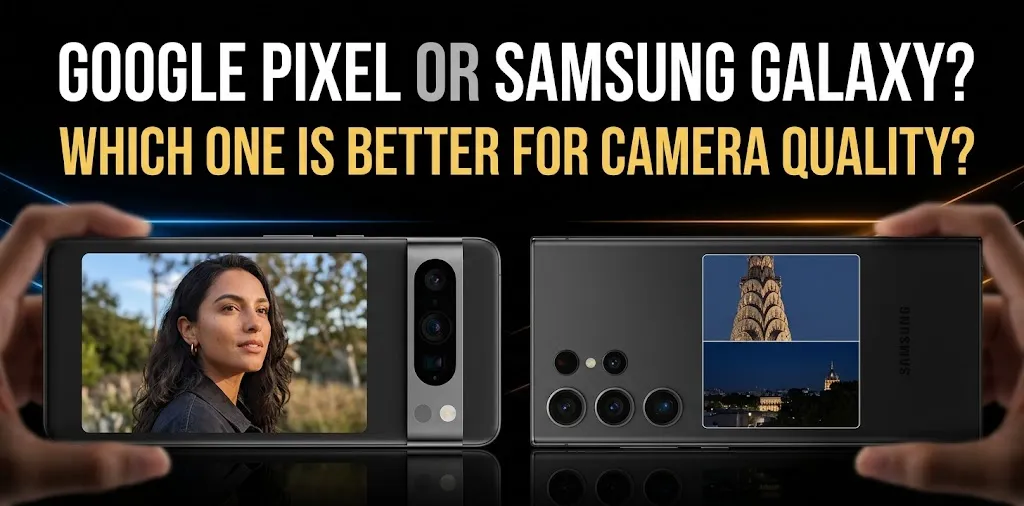
Google Pixel or Samsung Galaxy? Which one is better for camera quality?

If camera quality is your main priority, Google Pixel is usually the better choice for natural-looking photos, portraits, and easy point-and-shoot photography, while Samsung Galaxy is stronger for zoom, versatility, and video controls. At the high end, the Pixel 11 Pro and Galaxy S26 Ultra are both excellent, but they produce noticeably different results.
The answer depends less on megapixels and more on how you take photos. Google and Samsung use different approaches to image processing, color, zoom, night photography, portraits, and video.
For most people who want to take a photo, tap the shutter, and get a natural result without changing settings, Pixel has a slight edge. If you want a more versatile camera system with powerful zoom and more control, Galaxy is the better fit.
Pixel vs. Samsung Galaxy camera: the main difference
Google Pixel and Samsung Galaxy can both produce excellent photos, but they often make different choices when processing the same scene.
| Camera priority | Better choice | Why |
|---|---|---|
| Natural-looking photos | Pixel | Usually favors realistic tones and balanced processing |
| Portraits | Pixel | Strong subject separation and skin-tone processing |
| Point-and-shoot photos | Pixel | Excellent computational photography with little effort |
| Long-distance zoom | Galaxy | More flexible telephoto hardware, especially on Ultra models |
| Ultra-wide photography | Depends on model | Both are strong on current flagships |
| Night photography | Close | Both perform very well, with different processing styles |
| Video controls | Galaxy | Strong manual controls and a broad set of shooting options |
| AI photo editing | Both | Google and Samsung offer extensive AI-powered tools |
| Camera versatility | Galaxy | More dedicated zoom options on top models |
| Simple everyday photography | Pixel | Very easy to get a good-looking shot |
This is why there is no single winner for every photographer.
Google Pixel camera quality
Google’s biggest strength is not simply the camera hardware. It is the way Google’s software processes the image after you press the shutter.
The latest Pixel 11 Pro, for example, has a 50MP main camera, 48MP ultrawide camera, and 48MP 5x telephoto camera. Google also includes features such as Night Sight, Real Tone, High-Res Portrait Mode, Camera Coach, Magic Capture, and up to 120x Pro Zoom.
That combination makes Pixel particularly appealing if you do not want to spend time adjusting camera settings.
Pixel for natural-looking photos
Pixel phones have long focused on computational photography that tries to preserve detail, exposure, and skin tones without making every image look heavily processed.
That can be especially useful for:
- Family photos
- Children and pets
- Street photography
- Portraits
- Indoor photos
- Quick snapshots
- Photos where you want realistic-looking colors
Google’s Real Tone technology is also designed to handle a wide range of skin tones naturally.
The result is often a photo that looks closer to the scene you remember rather than a heavily saturated version of it.
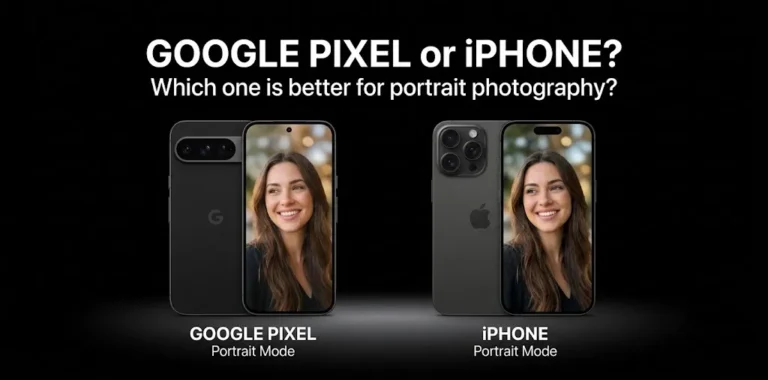
Pixel for portraits
Pixel is a particularly good option if portraits are one of your main priorities.
The Pixel 11 Pro supports High-Res Portrait Mode and includes Google’s portrait and face-processing tools. Its camera system also has a dedicated 5x telephoto camera, giving you more flexibility when taking portraits from a little farther away.
For someone taking pictures of friends, family, or people outdoors, Pixel’s image processing can be a major advantage.
Samsung Galaxy camera quality
Samsung takes a different approach.
Galaxy phones tend to give you a highly versatile camera system with strong hardware, multiple focal lengths, detailed images, and extensive shooting and editing options.
The Galaxy S26 Ultra is the clearest example. It has a 200MP main camera, 50MP ultrawide camera, 50MP 5x telephoto camera, and 10MP 3x telephoto camera. Samsung also offers up to 100x Space Zoom.
That gives Galaxy an important advantage when you want to photograph subjects at different distances.
Galaxy for zoom photography
If you frequently photograph things that are far away, Samsung is usually the stronger choice.
The Galaxy S26 Ultra has dedicated 3x and 5x telephoto cameras, while Samsung’s processing can extend the usable range much farther with digital and AI-assisted zoom. Samsung lists up to 100x Space Zoom on the S26 Ultra.
That can be useful for:
- Concerts
- Sporting events
- Travel
- Buildings and landmarks
- Wildlife
- Moon photography
- Distant subjects
A Pixel can also zoom impressively, but Samsung’s multi-telephoto setup gives Galaxy more flexibility across different distances.
Galaxy for low-light photography
Samsung has also put significant effort into improving low-light photography and video.
The Galaxy S26 Ultra uses a wider f/1.4 aperture on its 200MP main camera and a wider f/2.9 aperture on its 5x telephoto camera. Samsung says the wider apertures improve brightness in low-light shooting.
Independent comparisons show that the difference between current Pixel and Galaxy cameras can be small in many situations. In one Pixel 11 Pro and Galaxy S26 Ultra comparison, the two phones were often difficult to separate, with each producing strong results in different scenes.
So it would be misleading to say that one brand always wins at night.
Pixel vs. Galaxy for everyday photos
For everyday photography, Pixel is the easier recommendation if you want natural results with minimal effort.
Imagine you are walking through a city and see a good photo opportunity. You pull your phone out, point it at the scene, and take the picture.
Pixel is designed around that kind of experience.
You do not need to think much about settings. Google’s computational photography handles exposure, HDR, skin tones, sharpening, and other processing automatically.
Samsung can do the same, but its camera system gives you more flexibility if you want to experiment.
Pick Pixel if: you mostly want to point, shoot, and share.
Pick Galaxy if: you enjoy having more camera options and different focal lengths.
Pixel vs. Galaxy for portraits and people
For people photos, Pixel gets the edge for many users.
Google’s image processing is particularly good at handling skin tones and maintaining a natural appearance. The Pixel 11 Pro also has a 48MP 5x telephoto camera and high-resolution portrait features.
Samsung can produce excellent portraits too, but its processing may appeal more to people who prefer brighter, punchier images.
If your priority is natural skin tones and realistic-looking portraits, start with Pixel.
If you prefer brighter, more dramatic-looking photos, Galaxy may be more appealing.
Pixel vs. Galaxy for zoom
Samsung Galaxy wins for zoom versatility, especially with the Galaxy S26 Ultra.
The S26 Ultra has dedicated 3x and 5x telephoto cameras and supports up to 100x Space Zoom.
The Pixel 11 Pro has a 5x optical telephoto camera and up to 120x Pro Zoom, so the number on the box alone does not tell the whole story. Google’s system is designed to combine optical hardware and computational processing to produce usable zoom images.
In practical use, however, Samsung’s two dedicated telephoto cameras give it an advantage when you regularly switch between medium and long-distance subjects.
Pixel vs. Galaxy for video
This category is closer than it used to be.
The Pixel 11 Pro supports 8K video through Video Boost, 4K recording at up to 60fps, Pro Stable Video, Night Sight Video, and other stabilization and video tools.
The Galaxy S26 Ultra also has a strong video system, including improved low-light video processing and stabilization features. Samsung specifically highlights Nightography Video for recording in darker environments.
If you mainly record casual clips for social media, either phone can be an excellent choice.
If you want more control over different camera perspectives and shooting modes, Galaxy has an advantage.
Pixel vs. Galaxy camera hardware
Looking at megapixels alone can be misleading.
For example, the Galaxy S26 Ultra’s main camera has 200MP, while the Pixel 11 Pro has a 50MP main camera. That does not mean the Samsung automatically produces four times as much detail.
The actual image depends on the sensor, lens, stabilization, image processing, exposure, lighting, and how the phone combines multiple frames.
The Pixel 11 Pro uses a 1/1.3-inch main sensor, while Samsung’s S26 Ultra also uses a 1/1.3-inch main sensor. Their camera systems then take very different approaches to processing the resulting image.
This is why camera comparisons should focus on actual photography rather than megapixel numbers alone.
Which is better for different types of photography?
For family and everyday photos
Google Pixel is the better choice for most people.
Its point-and-shoot approach makes it easy to capture people, pets, food, and everyday moments without adjusting many settings.
For travel photography
This one is much closer.
Choose Pixel if you care most about natural photos and portraits.
Choose Galaxy if your trips involve distant landmarks, architecture, concerts, or subjects where zoom matters.
For social media photos
Both are excellent.
Pixel can be a better choice if you prefer realistic colors. Galaxy may suit you better if you like brighter and more vivid images straight from the camera.
For sports and distant subjects
Samsung Galaxy has the advantage because of its flexible telephoto system, particularly on the S26 Ultra.
The dedicated 3x and 5x telephoto cameras make it easier to frame subjects at different distances.
For portraits
Pixel gets a slight edge if your preference is natural skin tones and realistic processing.
For serious zoom photography
Samsung Galaxy is the stronger choice.
Its combination of dedicated telephoto cameras and high-range Space Zoom makes the S26 Ultra particularly versatile.
Pixel 11 Pro vs. Galaxy S26 Ultra: which camera is better?
If you are comparing Google’s current Pro flagship with Samsung’s top Galaxy phone, the difference is not simply “good camera vs. bad camera.”
Both are high-end camera phones.
The Pixel 11 Pro has a 50MP main camera, 48MP ultrawide camera, 48MP 5x telephoto camera, 42MP autofocus selfie camera, and up to 120x Pro Zoom.
The Galaxy S26 Ultra has a 200MP main camera, 50MP ultrawide camera, 50MP 5x telephoto camera, 10MP 3x telephoto camera, and up to 100x Space Zoom.
| Feature | Pixel 11 Pro | Galaxy S26 Ultra |
|---|---|---|
| Main camera | 50MP | 200MP |
| Ultra-wide | 48MP | 50MP |
| Telephoto | 48MP 5x | 10MP 3x + 50MP 5x |
| Max advertised zoom | 120x Pro Zoom | 100x Space Zoom |
| Portrait photography | Excellent | Excellent |
| Natural-looking photos | Excellent | Excellent |
| Zoom flexibility | Excellent | Excellent |
| AI editing | Strong | Strong |
| Low-light photography | Excellent | Excellent |
| Camera simplicity | Excellent | Very good |
| Manual/control options | Strong | Strong |
Real-world testing also shows that the gap can be surprisingly small. PhoneArena’s comparison of the Pixel 11 Pro and Galaxy S26 found an advantage for Pixel in its camera scoring, while other comparisons between Pixel 11 Pro and Galaxy S26 Ultra have found the phones extremely close in many scenes.
That tells you something important: there is no universal winner in every photo.
So, which one should you buy?
If your priority is overall photo quality with minimal effort, I would choose Google Pixel.
If your priority is zoom, camera versatility, and having more ways to control your shots, I would choose Samsung Galaxy.
For most everyday photographers, the Pixel’s natural processing and point-and-shoot experience make it especially appealing.
For photography enthusiasts, travelers, sports fans, and people who regularly photograph distant subjects, Galaxy’s more versatile camera hardware is hard to ignore.
If you are comparing specific phones rather than the two brands as a whole, the decision can change. A Galaxy S26 Ultra and a Pixel 11 Pro are a very different comparison from a standard Galaxy S26 and a standard Pixel 11.
Frequently Asked Questions
Is Google Pixel camera better than Samsung Galaxy?
Google Pixel is often the better choice for natural-looking photos, portraits, and simple point-and-shoot photography. Samsung Galaxy is generally stronger for zoom flexibility and offers a very versatile camera system, especially on the Galaxy S26 Ultra.
Which takes better photos at night, Pixel or Samsung?
Both Pixel and Samsung Galaxy produce excellent low-light photos on their current flagship phones. The Pixel often focuses on balanced, natural-looking processing, while Samsung can produce brighter-looking results and has made major improvements to low-light hardware and processing.
Is Samsung better than Pixel for zoom?
Samsung has the advantage for zoom versatility, particularly with the Galaxy S26 Ultra. Its dedicated 3x and 5x telephoto cameras and up to 100x Space Zoom give it a wider range of zoom options.
The bottom line
Google Pixel is the better camera choice for most people who want natural photos, strong portraits, and excellent results without adjusting settings. Samsung Galaxy is the better choice if zoom, camera versatility, and more advanced shooting options matter more to you.
If you are buying a phone mainly for its camera, compare the specific Pixel and Galaxy models you are considering rather than choosing a brand based only on reputation. That model-to-model comparison will tell you much more about the camera you will actually use.