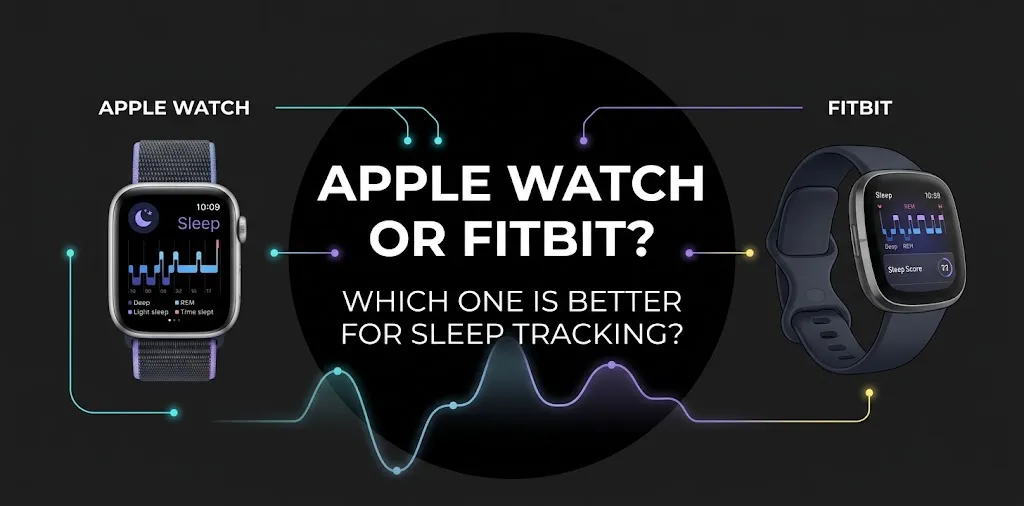
Apple Watch or Fitbit? Which one is better for sleep tracking?

For most people focused mainly on sleep tracking, Fitbit is usually the better choice because it puts more emphasis on easy-to-understand sleep insights, Sleep Scores, and long-term sleep trends. Apple Watch is the better option for iPhone users who also want a full smartwatch and broader health features. Neither device should replace a professional sleep evaluation.
The right choice depends on what you want to learn from your sleep.
If you simply want to know how long you slept and track basic sleep stages, both can work well. But if sleep data is one of your main reasons for buying a wearable, Fitbit and Apple Watch take noticeably different approaches.
| Feature | Apple Watch | Fitbit |
|---|---|---|
| Sleep duration | Yes | Yes |
| Sleep stages | Yes | Yes |
| Sleep score | Depends on software and features available | A major part of the Fitbit experience |
| Long-term sleep insights | Good | Strong focus |
| Battery life for overnight tracking | Usually requires frequent charging | Generally better on many Fitbit trackers |
| Smartwatch features | Excellent | More limited on many models |
| Best for iPhone users | Excellent | Good, depending on model |
| Best for sleep-focused buyers | Good | Usually the stronger choice |
Why Fitbit Is Often Better for Sleep-Focused Users
Fitbit has long made sleep tracking one of its main features. Its platform is designed to help users understand their sleep rather than simply show raw numbers.
Depending on the device and service level, Fitbit can provide information such as:
- Total sleep time
- Time awake
- Light, deep, and REM sleep
- Sleep Score
- Sleep trends
- Sleep Profile and additional insights on supported plans
Google’s Fitbit documentation shows that some advanced features and deeper sleep insights are associated with Fitbit Premium, so buyers should check which information is included with their chosen device and subscription.
The data is easier for many beginners to understand
This is one of Fitbit’s biggest advantages.
Imagine two people checking their sleep after a rough night.
One person sees several charts and health measurements and has to decide what matters. The other sees a clear sleep score and a summary showing that their sleep duration or schedule has been inconsistent.
For many beginners, the second experience is easier to use.
That does not automatically mean Fitbit is more medically accurate. It simply means its sleep experience is often more focused on helping everyday users understand patterns.
Better battery life can make sleep tracking easier
A sleep tracker is only useful if you actually wear it to bed.
Many Fitbit devices can run for several days between charges, while many Apple Watch models need more frequent charging. That can make Fitbit more convenient for people who want continuous overnight tracking without carefully planning when to charge their device.
For example, someone who wears a tracker all day, sleeps with it every night, and often forgets to charge electronics may find a Fitbit easier to live with.
Where Apple Watch Has the Advantage
Apple Watch is a stronger all-around device.
If you already use an iPhone and want sleep tracking alongside fitness tracking, notifications, apps, calls, safety features, and broader health tools, Apple Watch can be the more practical purchase.
Apple Watch fits naturally into the Apple ecosystem
Your sleep information works alongside the Apple Health app and other health data collected through your iPhone and Apple Watch.
That can be useful if you want one device for:
- Sleep tracking
- Workouts
- Heart rate monitoring
- Activity tracking
- Notifications
- Calls and messages
- Other Apple health features
Instead of buying a tracker mainly for sleep, you’re getting a full smartwatch that also tracks your nights.
Apple offers breathing disturbance and sleep apnea notifications on supported models
Supported Apple Watch models can track breathing disturbances during sleep and may notify eligible users when patterns suggest possible moderate to severe sleep apnea. Apple states clearly that this feature is not intended to diagnose sleep apnea or replace medical care.
This could matter to someone who wants broader sleep-related health monitoring rather than just a nightly sleep score.
For official details about Apple’s sleep apnea notifications and supported requirements, see Apple’s Sleep Apnea Notifications guide.
Which One Is More Accurate for Sleep Tracking?
There is no simple answer saying that one wearable is perfectly accurate.
Consumer wearables estimate sleep using sensors and algorithms. They can be useful for tracking patterns over time, but they are not the same as a clinical sleep study.
A 2026 study comparing Apple Watch Series 7 and Fitbit Charge 5 with polysomnography found that both devices showed limitations in measuring individual sleep stages. The overall results favored Apple Watch in that particular comparison, but neither device provided clinical-grade sleep-stage accuracy.
That distinction is important.
Use wearable data to watch trends, not diagnose yourself
Suppose your tracker shows that your sleep duration has dropped for several weeks after you started working late.
That trend can be useful.
But if your watch says you only got a small amount of deep sleep on one particular night, you should not assume something is medically wrong based on that single number.
Wearables are generally more useful for questions like:
- Am I sleeping less than usual?
- Is my bedtime becoming inconsistent?
- Has my sleep changed after changing my exercise routine?
- Do I appear to wake up more often than usual?
They are less reliable as a replacement for professional testing when you suspect a sleep disorder.
Apple Watch vs. Fitbit for Sleep Stages
Both Apple Watch and Fitbit can estimate sleep stages, including categories such as:
- REM sleep
- Light or core sleep
- Deep sleep
- Awake time
The problem is that sleep-stage numbers can look more precise than they really are.
Even research comparing commercial wearables with polysomnography has found meaningful differences between what the devices estimate and what clinical testing measures.
For that reason, don’t choose a device solely because it promises the most detailed breakdown of deep or REM sleep.
The better question is:
Which device will help you consistently track useful patterns over time?
For many sleep-focused users, Fitbit’s presentation makes those patterns easier to follow. For Apple users who already wear an Apple Watch daily, Apple Watch may be more convenient because everything stays in the same ecosystem.
The Battery Question Matters More Than Many Buyers Expect
Battery life can completely change your sleep-tracking experience.
Choose Fitbit if you dislike frequent charging
If you regularly forget to charge your devices, Fitbit can be the safer option.
You are more likely to get consistent sleep records when your tracker can stay on your wrist for multiple days.
Choose Apple Watch if you can build a charging routine
Apple Watch can still work very well for overnight tracking if you develop a routine.
For example, you might charge it while showering, getting ready in the morning, or relaxing before bed.
If that routine works for you, Apple’s shorter battery life may not be a major problem.
Which Is Better for an iPhone User?
For an iPhone owner, Apple Watch is usually the better overall device.
The connection between Apple Watch, iPhone, and the Apple Health ecosystem is one of its biggest strengths.
However, that doesn’t automatically mean it is the best choice for someone buying a wearable mainly for sleep.
Consider this situation:
A person wants notifications, apps, workout tracking, calls, and sleep monitoring. Apple Watch makes more sense.
Another person mainly wants to improve their sleep habits, monitor nightly trends, and avoid charging every day. A Fitbit may be the better fit.
Fitbit Premium Is an Important Factor to Consider
Before choosing Fitbit, pay attention to the difference between free features and Premium features.
Some deeper Fitbit insights, including certain Sleep Profile and Sleep Score breakdown features, may require Fitbit Premium.
This means the cheapest tracker is not necessarily the cheapest long-term option if you expect access to every advanced insight.
Apple Watch does not use the same Premium subscription model for its standard sleep tracking features, although the watch itself is generally a more expensive purchase.
So your decision should include both:
- The upfront device cost
- Any ongoing subscription you may want
Who Should Choose Apple Watch?
Apple Watch is the better choice if you:
- Already use an iPhone
- Want a full smartwatch
- Want sleep tracking alongside many other health and fitness features
- Want Apple’s broader health ecosystem
- Can manage more frequent charging
- Are interested in supported breathing disturbance and sleep apnea notification features
It’s especially appealing for someone who does not want to wear one device for daytime smartwatch features and another device for sleep.
Who Should Choose Fitbit?
Fitbit is usually the better choice if you:
- Care mainly about sleep and activity tracking
- Prefer longer battery life
- Want sleep information presented in a simple, easy-to-follow format
- Don’t need a full-featured smartwatch
- Want to track sleep trends consistently
- Prefer a device that can often stay on your wrist for several days
For a buyer whose first question is, “How can I better understand my sleep?”, Fitbit is generally the more sleep-focused platform.
My Recommendation: Apple Watch or Fitbit for Sleep Tracking?
Choose Fitbit if sleep tracking is your top priority.
Its sleep-focused experience, longer battery life on many models, and emphasis on understandable sleep insights make it a strong choice for people who mainly want to monitor their sleep habits.
Choose Apple Watch if you want the better overall smartwatch.
Apple Watch provides capable sleep tracking while also offering a much broader smartwatch and health experience, especially for iPhone users.
The most important thing is consistency. A tracker you comfortably wear every night will usually provide more useful long-term information than a technically advanced device that spends half its time charging on your nightstand.
FAQs
Is Fitbit more accurate than Apple Watch for sleep tracking?
Accuracy can vary by device, measurement, and study. Both can be useful for tracking sleep patterns, but research shows that consumer wearables have limitations when estimating individual sleep stages compared with clinical sleep testing.
Can Apple Watch detect sleep apnea?
Supported Apple Watch models can monitor breathing disturbances and provide notifications when patterns suggest possible moderate to severe sleep apnea for eligible users. It does not diagnose sleep apnea, and anyone concerned about their sleep should speak with a healthcare professional.
Is Fitbit worth buying just for sleep tracking?
It can be a good choice if sleep tracking is one of your main priorities. Before buying, check the specific Fitbit model and which advanced sleep insights are included for free versus those connected to Fitbit Premium.
Final Verdict
For sleep tracking alone, Fitbit is the better choice for most people. For an iPhone user who wants excellent sleep tracking plus a complete smartwatch experience, Apple Watch is the stronger overall choice.
Before buying, compare the specific models you’re considering—not just the Apple Watch and Fitbit brands—and choose the one you will be comfortable wearing consistently every night.