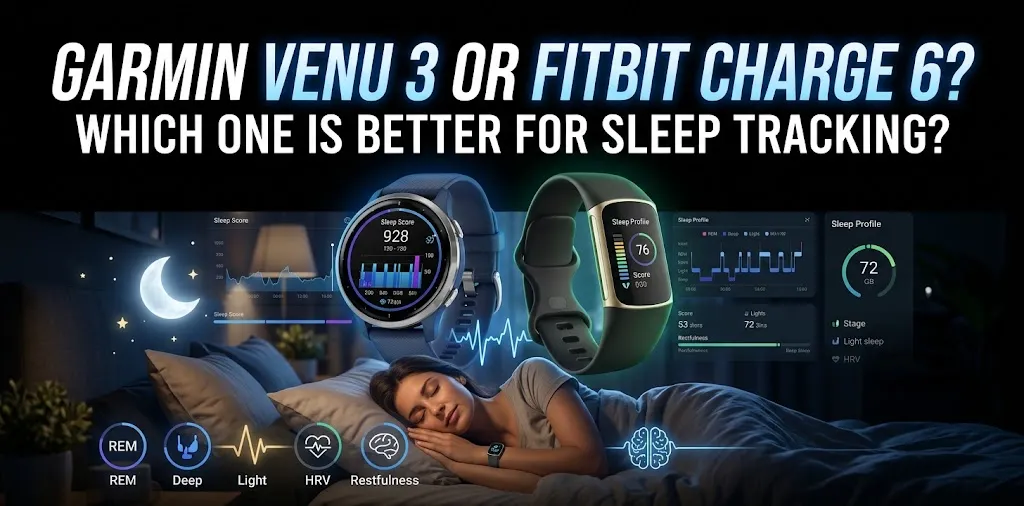
Garmin Venu 3 or Fitbit Charge 6? Which one is better for sleep tracking?

If sleep tracking is your main priority, the Garmin Venu 3 is the better overall choice because it combines sleep stages, sleep score, sleep coaching, naps, HRV status, and recovery data without requiring a premium subscription for its core sleep features. The Fitbit Charge 6 is still an excellent option, especially if you want a smaller tracker and a simpler sleep-focused experience.
Garmin Venu 3 vs. Fitbit Charge 6 for sleep tracking
Both devices can track your sleep duration, sleep stages, heart rate, and other overnight measurements. The bigger difference is how each platform turns that information into useful guidance.
| Sleep feature | Garmin Venu 3 | Fitbit Charge 6 |
|---|---|---|
| Sleep duration | Yes | Yes |
| Light, deep, and REM sleep | Yes | Yes |
| Sleep score | Yes | Yes |
| Sleep coaching | Yes | Yes, with some features requiring Premium |
| Automatic nap detection | Yes | Naps are tracked, but Garmin has a stronger dedicated nap feature |
| HRV information | Yes | Yes |
| Overnight SpO2 | Yes | Yes |
| Breathing-related information | Yes | Yes |
| Sleep Profile | No | Yes, Premium |
| Readiness/recovery insights | Body Battery and Garmin recovery features | Readiness Score |
| Core sleep tracking without subscription | Yes | Yes |
| Battery life | Up to 14 days in smartwatch mode | Up to 7 days |
Garmin says the Venu 3’s sleep tracking uses heart rate, HRV, movement, and other signals to estimate sleep and wake periods and different sleep stages. Its Sleep Coach also considers sleep history, activity, HRV status, and naps.
The Charge 6 also tracks sleep stages and produces a sleep score. Google Health says Fitbit estimates sleep stages using movement and heart-rate patterns from the wrist rather than the brain and muscle sensors used in a clinical sleep study.
Which gives you more useful sleep information?
The Garmin Venu 3 has the edge for people who want to understand how sleep affects their overall recovery.
You get a Sleep Score, Sleep Coach, sleep stages, naps, and HRV-related information. Garmin also connects sleep data with Body Battery and other recovery features, so the watch can help you decide whether you are ready for a hard workout or should take an easier day.
The Charge 6 is more focused on presenting sleep information in a simple way. It tracks sleep stages, sleep score, breathing-related information, heart rate, HRV, skin temperature, and other health metrics.
For someone who simply wants to answer “How long did I sleep, and was it a good night?”, the Charge 6 may be enough.
For someone asking “How did last night’s sleep affect my recovery today?”, Garmin is more useful.
Sleep stages: Venu 3 vs. Charge 6
Both devices estimate three main sleep-stage categories: light, deep, and REM sleep.
The Venu 3 uses heart rate, HRV, and movement information as part of its sleep-tracking system. Garmin then uses those measurements to generate its Sleep Score and sleep-stage information.
The Charge 6 similarly estimates sleep stages from wrist-based movement and heart-rate patterns. Google explains that Fitbit’s light-sleep category broadly represents N1/N2 sleep, while deep sleep is intended to represent N3 sleep.
Neither device should be treated as a replacement for a clinical sleep study. A smartwatch or fitness tracker estimates sleep stages from wrist signals; it does not directly measure the brain activity used in clinical polysomnography.
So if your main reason for buying one is to see whether you had 1 hour and 40 minutes of deep sleep rather than 1 hour and 20 minutes, don’t assume that small differences between devices represent a medically meaningful change.
For everyday tracking, look for trends over many nights rather than judging your sleep from one night’s stage breakdown.
Sleep score and sleep coaching
Garmin gives the Venu 3 a Sleep Score from 0 to 100. Garmin says the score considers sleep duration and quality, including sleep-stage patterns, awake time, restlessness, and other information.
The Charge 6 also provides a Sleep Score based on factors including time asleep, heart rate, and restlessness.
The difference is what happens after you receive the score.
Garmin’s Sleep Coach can use your sleep history, activity history, HRV status, and naps to provide a recommended sleep need.
Fitbit’s platform provides additional sleep insights, but some deeper features are part of its Premium service. Google currently lists the Sleep Profile and Sleep Score breakdown among Premium features.
That makes Garmin the better choice if you want more sleep-related guidance included with the device itself.
Naps can make Garmin a better choice
Naps are one area where the Venu 3 has a clear advantage.
Garmin’s Venu 3 automatically detects naps and adds them to your sleep statistics. Garmin says naps can also influence recovery information and the Sleep Coach.
Fitbit can record naps, but its sleep-stage system has limitations. Google says sleep stages require at least 20 minutes of sleep data, and some naps may not receive complete stage information.
This matters if your schedule includes daytime sleep.
For example, a person who sleeps seven hours at night and regularly takes a 30-minute afternoon nap may get more useful recovery context from the Venu 3 because Garmin explicitly incorporates naps into its sleep and recovery ecosystem.
Which is more comfortable to wear overnight?
The Fitbit Charge 6 is the better pick if you prefer a smaller, simpler device on your wrist while sleeping.
The Charge 6 is a fitness tracker rather than a full-size smartwatch, so it has a less noticeable form factor for people who don’t like wearing a larger watch in bed.
The Venu 3 is still designed for 24/7 wear, and its long battery life makes overnight tracking convenient. But it is physically more like a traditional smartwatch.
This can become important because the best sleep tracker is the one you actually wear every night.
If a larger watch bothers you while sleeping, the Venu 3’s extra sleep features won’t help much if you regularly take it off before bed.
Battery life matters more than it seems
Garmin lists up to 14 days of battery life for the Venu 3 in smartwatch mode. Garmin specifically designed the watch for continuous health tracking, including overnight sleep monitoring.
The Charge 6 is rated for up to 7 days of battery life.
Both are long-lasting enough to make overnight tracking practical. However, Garmin has an advantage because you have more flexibility about when to charge it.
That can reduce one of the biggest problems with sleep trackers: forgetting to wear the device because it is sitting on a charger.
What about HRV and recovery?
If you care about sleep plus recovery, Garmin has a stronger overall system.
The Venu 3 measures HRV during sleep and establishes an HRV status based on your baseline. Garmin says the watch needs about three weeks of consistent sleep data before it can display HRV status.
This can be useful because your sleep duration isn’t the only thing that changes from night to night. Recovery-related measurements can provide additional context about how your body is responding to training, stress, and rest.
The Charge 6 also records HRV and other overnight health metrics.
However, Fitbit’s biggest strength is its simpler presentation, while Garmin is better suited to people who want sleep data connected with exercise and recovery.
Which one should you buy for sleep tracking?
Choose the Garmin Venu 3 if:
- Sleep and recovery are both important to you.
- You want automatic nap detection.
- You want Sleep Coach recommendations.
- You want sleep data connected with HRV and Body Battery.
- You want longer battery life.
- You do not want your main sleep features tied to a premium subscription.
Choose the Fitbit Charge 6 if:
- You primarily want basic sleep and health tracking.
- You prefer a smaller fitness tracker.
- You want a simpler experience.
- You care about Fitbit’s sleep ecosystem and Google Health integration.
- You don’t need Garmin’s broader training and recovery features.
Two real-world buying situations
Imagine you mainly want to know whether you’re getting enough sleep each night and you don’t do structured workouts. The Charge 6 may make more sense because you can get sleep duration, stages, sleep score, and other health information without paying for a larger smartwatch.
Now imagine you run several times a week and want to understand how poor sleep affects your training. The Venu 3 makes more sense because sleep, HRV, naps, Body Battery, and training information work together rather than existing as separate measurements.
Are either of them accurate enough for sleep tracking?
Both can be useful for tracking personal sleep patterns, but neither should be treated as a clinical sleep-monitoring device.
Wrist-based devices estimate sleep and sleep stages from signals such as movement and heart rate. Google explicitly describes Fitbit’s sleep-stage system as an estimate based on wrist signals rather than the sensors used in a clinical sleep laboratory.
The most useful approach is to watch your long-term trends:
- How long you usually sleep
- Whether your bedtime is consistent
- How often you wake up
- Changes in your sleep score
- Changes in HRV or recovery
- Whether your sleep patterns change when your activity or schedule changes
Don’t panic over a single unusual sleep-stage result.
Frequently Asked Questions
Still deciding between the Garmin Venu 3 and Fitbit Charge 6 for sleep tracking? These common questions can help you compare their sleep features, accuracy, and subscription requirements before choosing one.
Is Garmin Venu 3 better than Fitbit Charge 6 for sleep tracking?
Yes, the Venu 3 has the stronger overall sleep and recovery system. It adds Sleep Coach, automatic nap detection, HRV status, and deeper connections between sleep and recovery without requiring a premium subscription for those core Garmin features.
Does Fitbit Charge 6 track REM and deep sleep?
Yes. The Charge 6 tracks estimated REM, light, and deep sleep stages when sufficient sleep data is available. Google explains that Fitbit estimates these stages using movement and heart-rate patterns from the wrist.
Do you need Fitbit Premium for sleep tracking on the Charge 6?
No. Basic sleep tracking and sleep stages are available without Premium. However, Google currently lists features such as Sleep Profile and the Sleep Score breakdown among Premium features, so some of the deeper sleep insights require a subscription.
Final verdict
For sleep tracking alone, the Garmin Venu 3 is the better overall choice, mainly because its sleep data connects more deeply with Sleep Coach, naps, HRV, Body Battery, and recovery. The Fitbit Charge 6 remains a strong alternative if you want a smaller device and a straightforward sleep-tracking experience.
One practical tip: if you are choosing between these two specifically for sleep, prioritize comfort and whether you’ll wear it every night over small differences in estimated sleep-stage numbers. Consistent data over weeks is much more useful than a supposedly perfect reading from one night.


3 Comments