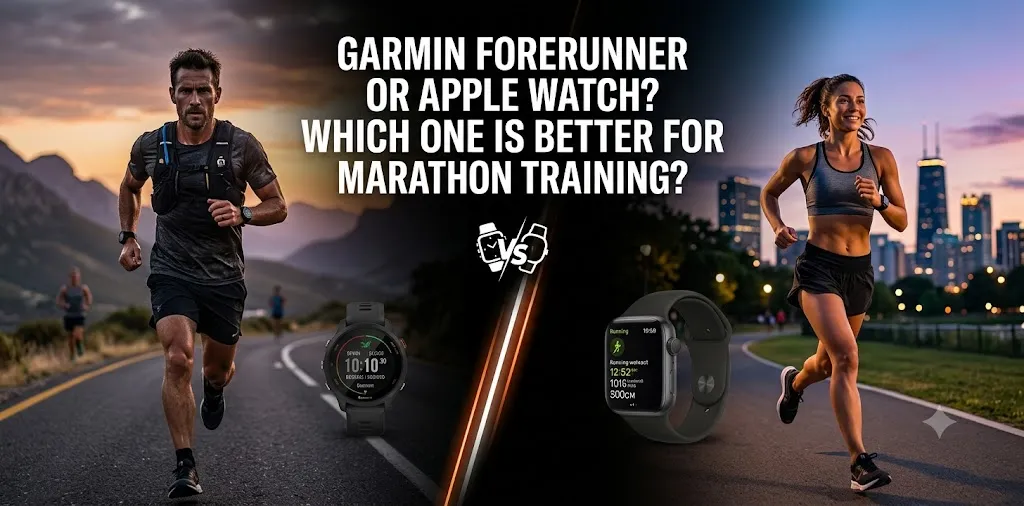
Garmin Forerunner or Apple Watch? Which one is better for marathon training?

For marathon training, Garmin Forerunner is the better choice for most serious runners because it puts more emphasis on structured training, recovery, race preparation, and long-distance battery life. Apple Watch is still an excellent option, especially for iPhone users who want strong running features plus a full-featured smartwatch.
The better choice depends on what you want from your watch. If the watch is mainly a training tool for running a marathon, Garmin has the edge. If you want one device that handles running, calls, messages, apps, music, health tracking, and everyday smartwatch duties, Apple Watch may make more sense.
Garmin Forerunner vs. Apple Watch for Marathon Training
The biggest difference is not basic GPS tracking. Both platforms can record distance, pace, heart rate, running power, cadence, and other useful running data. The bigger difference is how each platform turns that data into a training system.
Current Forerunner models such as the Forerunner 570 and 970 offer features built specifically around running and race preparation, including training readiness, training status, daily suggested workouts, recovery information, race planning, and multi-band GPS.
Apple Watch has also become much stronger for runners. Current Apple Watch models support custom workouts, customizable workout views, training load, heart-rate zones, VO2 max, race routes, pacing tools, running dynamics, and automatic track detection.
| Feature | Garmin Forerunner | Apple Watch |
|---|---|---|
| Marathon-focused training | Excellent | Very good |
| Structured workouts | Excellent | Excellent |
| Training readiness | Excellent | Good |
| Recovery insights | Excellent | Good |
| Race planning | Excellent | Very good |
| GPS running features | Excellent | Excellent |
| Long-run battery | Excellent | Very good, especially Ultra |
| Everyday smartwatch features | Very good | Excellent |
| iPhone integration | Good | Excellent |
| Android compatibility | Yes | No |
| Best for serious runners | Garmin | — |
| Best for general smartwatch use | — | Apple Watch |
Why Garmin Forerunner Is Better for Marathon Training
Garmin’s main advantage is that running is at the center of the Forerunner experience.
For example, the Forerunner 570 can provide daily suggested workouts that adapt based on your performance and recovery. Garmin also provides training readiness and training status information, while compatible Forerunner models can use race events and course information to help organize preparation for a marathon.
That matters because marathon training is not just about recording miles. You need to balance:
- Easy runs
- Long runs
- Tempo or threshold work
- Intervals
- Recovery
- Rest days
- Weekly training load
- Race pace
- Fatigue
Garmin’s training system is designed to bring many of these factors together.
Garmin’s training readiness can be useful
On compatible Forerunner models, Training Readiness combines information such as sleep, recovery time, HRV status, acute training load, recent sleep history, and recent stress history. The result is intended to help you judge how prepared you are for training that day.
It should not be treated as a medical measurement or as a command that you must obey. Think of it as another piece of information alongside how your legs actually feel.
Garmin is strong for structured workouts
If your marathon plan calls for something like:
10-minute warm-up → 4 × 1 mile at a target pace → 3-minute recovery between repeats → cooldown
a Forerunner can guide you through the workout on the watch. Garmin’s current Forerunner models support scheduled and saved workouts, interval sessions, training targets, and training calendars.
That can be much easier than repeatedly checking your phone during a hard workout.
Battery Life Matters More Than You Might Expect
Battery life becomes important when marathon training includes long runs, frequent workouts, sleep tracking, and race-day GPS recording.
The Forerunner 970, for example, is rated for up to 26 hours in GPS-only mode, 23 hours in Auto Select GNSS mode, or 21 hours with multi-band GNSS. With music playback, those figures are lower.
Apple’s current Ultra line also offers much better endurance than standard Apple Watch models. The Apple Watch Ultra 3 was rated for up to 42 hours of normal use and up to 72 hours in Low Power Mode.
So the battery gap is not as simple as “Garmin lasts and Apple Watch doesn’t.”
For a marathon runner, the more useful distinction is this:
Garmin generally gives you more battery headroom for long training blocks and long GPS activities, while Apple Watch Ultra has made the gap much smaller.
If you are comparing a Forerunner with a standard Apple Watch rather than an Ultra, Garmin’s advantage becomes more noticeable.
GPS Accuracy: Garmin vs. Apple Watch
Both brands now offer strong GPS performance, and the difference is less dramatic than it was with older generations.
Garmin’s Forerunner 570 and 970 support multi-band GPS, while the Apple Watch Ultra 3 uses precision dual-frequency GPS.
This can matter when you run around:
- Tall buildings
- Dense neighborhoods
- Tree-covered roads
- Curved city streets
- Areas where GPS signals are more difficult
For most runners, either watch should provide useful pace and distance data. The bigger advantage of Garmin is that GPS is combined with a broader running-focused training ecosystem.
Which Is Better for Long Runs?
Garmin Forerunner wins.
A marathon training plan often builds toward long runs that can last two, three, or even more hours depending on the runner.
Garmin’s longer battery life gives you more breathing room, particularly on higher-end Forerunner models. It also makes it easier to keep the watch on between workouts and overnight for recovery-related data.
Apple Watch Ultra is a much stronger choice than a standard Apple Watch for this use. Apple specifically supports running features such as customizable workout views, pacing, race routes, training load, heart-rate zones, and running dynamics on the Ultra 3.
But if marathon training is your main reason for buying the watch, Garmin still has the more focused package.
Which Is Better for Marathon Race Day?
Both can work very well on race day.
A marathon runner typically cares about:
- Current pace
- Average pace
- Distance
- Heart rate
- Lap or mile splits
- Remaining distance
- Target pace
- Battery life
- Easy-to-read data
- Reliable GPS
Garmin’s race-focused features give it an advantage for runners who like to prepare and follow a detailed pacing strategy. Garmin also supports race-event planning and projected race-time information on compatible Forerunner models.
Apple Watch is also capable of serious race-day use. Its current running tools include Pacer, Race Route, custom workouts, heart-rate zones, and customizable workout views.
One important point: the watch will not run the marathon for you. A pacing feature is only useful if the target pace is realistic and you understand how to adjust it for hills, heat, crowds, and how you actually feel.
Apple Watch Has One Major Advantage: The iPhone Ecosystem
If you already use an iPhone, Apple Watch becomes much more attractive.
Apple Watch combines running tools with the broader Apple ecosystem, including notifications, calls, messages, apps, music, Apple Pay, and health features.
Apple’s current running system also goes well beyond basic distance tracking. You can create custom workouts, select different workout views, set a running pace, race a previous performance, and review training load after your run.
For someone who runs three or four times a week but also wants a premium everyday smartwatch, Apple Watch can be the better overall device.
What About Android Users?
This is an easy decision.
Choose Garmin if you use Android.
Apple Watch is designed around the iPhone, while Garmin Forerunner watches can work with both iPhone and Android phones. Garmin’s current Forerunner 570 and 970 support smart notifications when paired with compatible smartphones.
So your phone ecosystem should be one of the first things you consider.
Which Garmin Forerunner Should You Consider?
“Garmin Forerunner” is a family of watches, not one single model.
For marathon training, the current range includes models with different levels of running features and price.
Forerunner 570
The Forerunner 570 is aimed at runners who want advanced training features without moving to Garmin’s most premium running watch.
It includes multi-band GPS, training readiness, training status, daily suggested workouts, race planning tools, and advanced running metrics.
For many marathon runners, this is the sweet spot.
Forerunner 970
The Forerunner 970 is the more premium option. It adds features such as built-in mapping, sapphire glass, a titanium bezel, and additional running metrics. Garmin also gives it longer battery life and features such as running tolerance.
It makes more sense for runners who want advanced data, mapping, and a premium running watch rather than simply a device for recording runs.
Older Forerunner models
You do not necessarily need the newest Forerunner.
Older models such as the Forerunner 265 can still provide a strong running experience, including advanced training metrics and multi-band GPS.
If you find an older model at a substantially lower price, it may offer better value than paying for features you will never use.
A Practical Choice for Different Runners
Consider two hypothetical runners.
Runner A is training for a first marathon. They run four days a week, use an iPhone, enjoy podcasts and messages on their wrist, and do not care about advanced recovery statistics.
For this runner, an Apple Watch can be a very good choice. Its current running tools are more than capable of recording the training needed for a marathon.
Runner B is following a detailed marathon plan, does intervals and tempo runs every week, wants training-load and recovery information, tracks sleep, and wants long battery life.
For this runner, a Garmin Forerunner makes more sense because its training ecosystem is built around these needs.
Garmin Forerunner or Apple Watch: Which One Should You Buy?
Choose a Garmin Forerunner if:
- Marathon training is your main priority.
- You want deeper running and recovery metrics.
- You want adaptive or structured training guidance.
- You regularly do long runs.
- You want more battery life.
- You use Android or want the freedom to switch between phone platforms.
- You want a watch designed primarily around training.
Choose an Apple Watch if:
- You already use an iPhone.
- You want a smartwatch first and a running watch second.
- Calls, messages, apps, music, and everyday features matter as much as running.
- You want strong running features without moving into a dedicated running ecosystem.
- You prefer Apple’s interface and ecosystem.
- You are considering an Apple Watch Ultra and want a more endurance-focused Apple option.
Frequently Asked Questions
Before choosing between a Garmin Forerunner and an Apple Watch for marathon training, it helps to understand how they differ in training features, battery life, race-day tools, and everyday smartwatch functions. Here are three common questions runners ask before making the choice.
Is Garmin better than Apple Watch for marathon training?
Yes, Garmin is generally better for runners who want a dedicated marathon-training experience. Its Forerunner lineup places more emphasis on training readiness, recovery, structured workouts, race preparation, and long battery life.
Can an Apple Watch handle marathon training?
Yes. Apple Watch supports custom workouts, pacing tools, race routes, training load, heart-rate zones, VO2 max, and several running-dynamics metrics. The Apple Watch Ultra models also offer substantially more battery capacity than standard Apple Watch models.
Is Garmin or Apple Watch better for marathon race day?
Garmin has the edge if your priority is race-focused training and pacing, while Apple Watch is an excellent choice for runners who also want a full smartwatch. Your phone ecosystem, preferred training tools, and expected race duration should be part of the decision.
The Bottom Line
For marathon training specifically, Garmin Forerunner is the better overall choice. Its strongest advantage is not simply GPS or battery life; it is the way Garmin connects workouts, recovery, training load, race preparation, and running metrics into one system.
Apple Watch is the better choice if you want your running watch to double as your main smartwatch and you already live in the Apple ecosystem. Current Apple Watch models have become serious running tools, so choosing Apple does not mean giving up good marathon features.
For most runners deciding strictly on “Which is better for marathon training?”, I’d choose Garmin Forerunner. If you are buying one device to handle both marathon training and everyday life, compare the specific Forerunner model with the specific Apple Watch model before making the final decision.